

If you’re an American living abroad, filing your US expat tax return may feel like solving a puzzle with missing pieces. You’re juggling foreign tax systems, currency conversions, and IRS requirements that seem designed for people who never left Main Street, USA.
I’m Mark Anderson, a CPA with over 15 years of experience helping American expats navigate the complex world of US taxation. Every tax season, I meet clients who thought they were exempt from US taxes simply because they live overseas. Unfortunately, Uncle Sam doesn’t see it that way.
The truth is straightforward: if you’re a US citizen or green card holder, you’re required to file US taxes regardless of where you call home. But here’s the good news—with the right checklist and understanding of expat-specific tax benefits, you can file confidently and potentially save thousands in taxes.
Why American Expats Must File US Taxes Abroad
The United States operates on a citizenship-based taxation system, making it one of only two countries worldwide (alongside Eritrea) with this approach. This means your tax obligations follow your passport, not your address.
Imagine you’re David, a software engineer who moved from Portland to Berlin three years ago. He earns €75,000 annually, pays German taxes, and assumed he was done with US tax obligations. Then he received a letter from the IRS requesting three years of unfiled returns, along with substantial penalties.
David’s story isn’t unique. The IRS estimates that millions of Americans abroad remain non-compliant, often unknowingly. Here’s what triggers US expat tax filing requirements:
Your worldwide income exceeds the filing threshold (for 2025, this is $15,750 for single filers under 65). You have self-employment income over $400, regardless of total earnings. You maintain US financial accounts or have signature authority over foreign accounts exceeding $10,000 at any point during the tax year.
Even if you don’t owe taxes due to exclusions like the Foreign Earned Income Exclusion (FEIE), you still must file to claim these benefits. Think of it as paperwork that protects you from future headaches.
Key 2025 US Expat Tax Deadlines You Can’t Miss
Missing expat tax deadlines can trigger penalties that quickly spiral out of control. As someone who’s helped clients navigate IRS penalty abatement procedures, I can’t stress enough how prevention beats cure.
Here’s your complete timeline for 2025 expat tax deadlines:
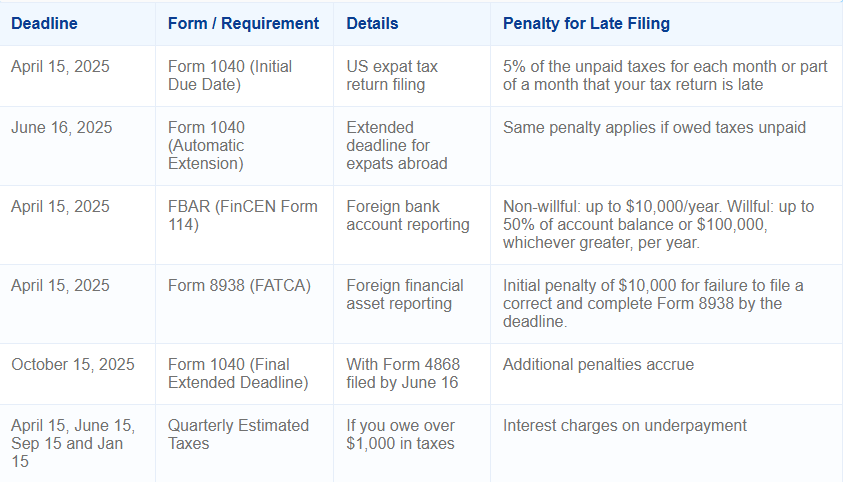
The automatic two-month extension to June 16 applies if your tax home and abode are outside the US on the regular April 15 deadline. However, any taxes owed must still be paid by April 15 to avoid interest charges.
Consider Maria, an American consultant in Barcelona who filed her return on time but forgot about FBAR requirements. Her penalty for late FBAR filing exceeded $25,000—more than she earned in some quarters. Don’t let paperwork oversights cost you thousands.
Step-by-Step Checklist for Filing Your Expat Tax Return
Filing US expat taxes requires methodical preparation. I’ve developed this checklist after helping hundreds of expats organize their documents and maximize their tax benefits.
Phase 1: Document Collection (Start 60 days before filing)
Gather all Forms W-2, 1099, and foreign equivalent income statements. Convert all foreign income to USD using IRS-approved exchange rates (use the IRS yearly average exchange rate table). Collect foreign tax documents showing taxes paid to your country of residence. Obtain statements for all foreign bank accounts, investment accounts, and retirement plans.
Phase 2: Determine Your Tax Home and Qualifying Tests
Your tax home determines eligibility for the Foreign Earned Income Exclusion and Foreign Housing Exclusion. You must pass either the Physical Presence Test (330+ days outside the US in a 365-day period) or the Bona Fide Residence Test (genuine residence in a foreign country for an uninterrupted tax year).
Take James, an American teacher in Thailand who travels frequently to neighboring countries for vacation. He carefully tracks his travel dates to ensure he meets the Physical Presence Test, allowing him to exclude $130,000 of his teaching income in 2025.
Phase 3: Choose Your Expat Tax Strategy
You’ll typically choose between the Foreign Earned Income Exclusion (FEIE) or Foreign Tax Credit (FTC). FEIE excludes up to $130,000 of foreign earned income but you lose that exclusion amount for Social Security credits. FTC allows dollar-for-dollar credit for foreign taxes paid, often better for high-tax countries like Germany or France.
Phase 4: Complete Required Forms
Form 1040 serves as your main tax return, just like domestic filers. Form 2555 claims the Foreign Earned Income Exclusion and Foreign Housing Exclusion. Form 1116 claims the Foreign Tax Credit for taxes paid to foreign governments. Form 8938 reports foreign financial assets if thresholds are met. FinCEN Form 114 (FBAR) reports foreign bank accounts separately from your tax return.
Phase 5: Review and File
Double-check currency conversions using consistent exchange rates throughout your return. Verify that your foreign address is correctly formatted for IRS systems. Confirm all required signatures and dates are complete. File electronically when possible—paper returns from abroad face significant delays.
Common Mistakes Expats Make (and How to Avoid Them)
In my 15+ years of expat tax preparation, I’ve seen recurring mistakes that cost clients money and peace of mind. Here are the most expensive errors and how to sidestep them.
Mistake #1: Assuming No Filing Requirement
Many expats believe earning foreign income exempts them from US tax obligations. This misconception leads to years of non-compliance and substantial penalties. Remember: citizenship, not residence, determines your US tax filing requirement.
Mistake #2: Incorrect FEIE vs. FTC Elections
Choosing between Foreign Earned Income Exclusion and Foreign Tax Credit requires careful analysis. Sarah, a financial advisor in London, initially chose FEIE but missed out on $3,200 in refundable credits. After we amended her return using FTC, she received a substantial refund.
The rule of thumb: FEIE works well in low-tax countries, while FTC typically benefits expats in high-tax jurisdictions. However, your specific situation (income level, family status, other credits) determines the optimal choice.
Mistake #3: FBAR and FATCA Confusion
Foreign Bank Account Report (FBAR) and Foreign Account Tax Compliance Act (FATCA) reporting overlap but serve different purposes. FBAR requires reporting if your aggregate foreign account balance exceeds $10,000 at any point during the year. FATCA (Form 8938) has higher thresholds but broader asset coverage.
Michael, an American entrepreneur in Singapore, filed FATCA forms but overlooked FBAR requirements. The IRS assessed penalties exceeding $50,000 for three years of non-compliance. Both forms matter—don’t assume one covers the other.
Mistake #4: Currency Conversion Errors
Inconsistent exchange rates throughout your return trigger IRS scrutiny. Use the IRS yearly average exchange rate table for income items and daily rates for specific transactions when required. Document your methodology and stick with it consistently.
Mistake #5: State Tax Oversights
Some US states maintain tax claims on former residents even after moving abroad. California, New York, and Virginia are particularly aggressive in maintaining tax jurisdiction. Properly establish non-residency before departure to avoid dual taxation scenarios.
How Mark Anderson, CPA, Helps with Expat Taxes
After 15+ years specializing in US expat taxation, I’ve developed streamlined processes that save clients time while maximizing their tax benefits. My approach combines technical expertise with practical understanding of expat life challenges.
Personalized Tax Strategy Development
Every expat situation is unique. Whether you’re a digital nomad bouncing between countries, a corporate executive on long-term assignment, or a retiree who relocated for lifestyle reasons, your tax strategy must align with your specific circumstances.
I analyze your income sources, foreign tax obligations, and long-term plans to recommend optimal tax elections. This includes timing considerations for FEIE vs. FTC elections, retirement account strategies, and state tax planning.
Comprehensive Compliance Management
US expat tax compliance extends far beyond Form 1040. I ensure you meet all reporting requirements including FBAR, FATCA, and specialized forms for foreign trusts, partnerships, or corporations. My systematic approach prevents costly oversights that trigger penalties.
IRS Representation and Problem Resolution
When the IRS sends notices or initiates examinations, you need experienced representation. I handle correspondence, negotiate penalty abatements, and represent clients during audits. My established relationships with IRS expat specialists expedite resolution processes.
Year-Round Support and Planning
Tax planning shouldn’t wait until filing season. I provide ongoing guidance for major life events like job changes, relocations, marriage, or business formation. Proactive planning prevents problems and optimizes your overall tax situation.
My US Expat Tax Services include comprehensive preparation, planning, and representation services designed specifically for Americans living abroad.
Final Thoughts & Next Steps
Filing US expat taxes doesn’t have to feel overwhelming when you have the right guidance and systematic approach. The key lies in understanding your obligations, meeting deadlines, and leveraging available exclusions and credits to minimize your tax burden.
Remember these essential takeaways: US citizens must file regardless of where they live or earn income. The June 16 automatic extension provides breathing room, but don’t procrastinate on gathering documents. Choose between FEIE and FTC based on your specific situation, not general rules. FBAR and FATCA reporting carry severe penalties—don’t overlook these requirements.
Starting your 2025 tax preparation early gives you time to organize documents, understand your options, and make informed decisions. Rushing through expat tax preparation leads to missed opportunities and potential errors.
If you’re feeling overwhelmed by US expat tax requirements or want to ensure you’re maximizing your available benefits, I’m here to help. With over 15 years of specialized experience in expat taxation, I can guide you through the process while you focus on enjoying life abroad.
Ready to tackle your 2025 US expat taxes with confidence? Contact me today for a consultation where we’ll review your specific situation and develop a comprehensive tax strategy that works for your expat lifestyle.
Don’t let tax compliance stress overshadow the adventure of living abroad. Let’s work together to keep you compliant while minimizing your tax burden.